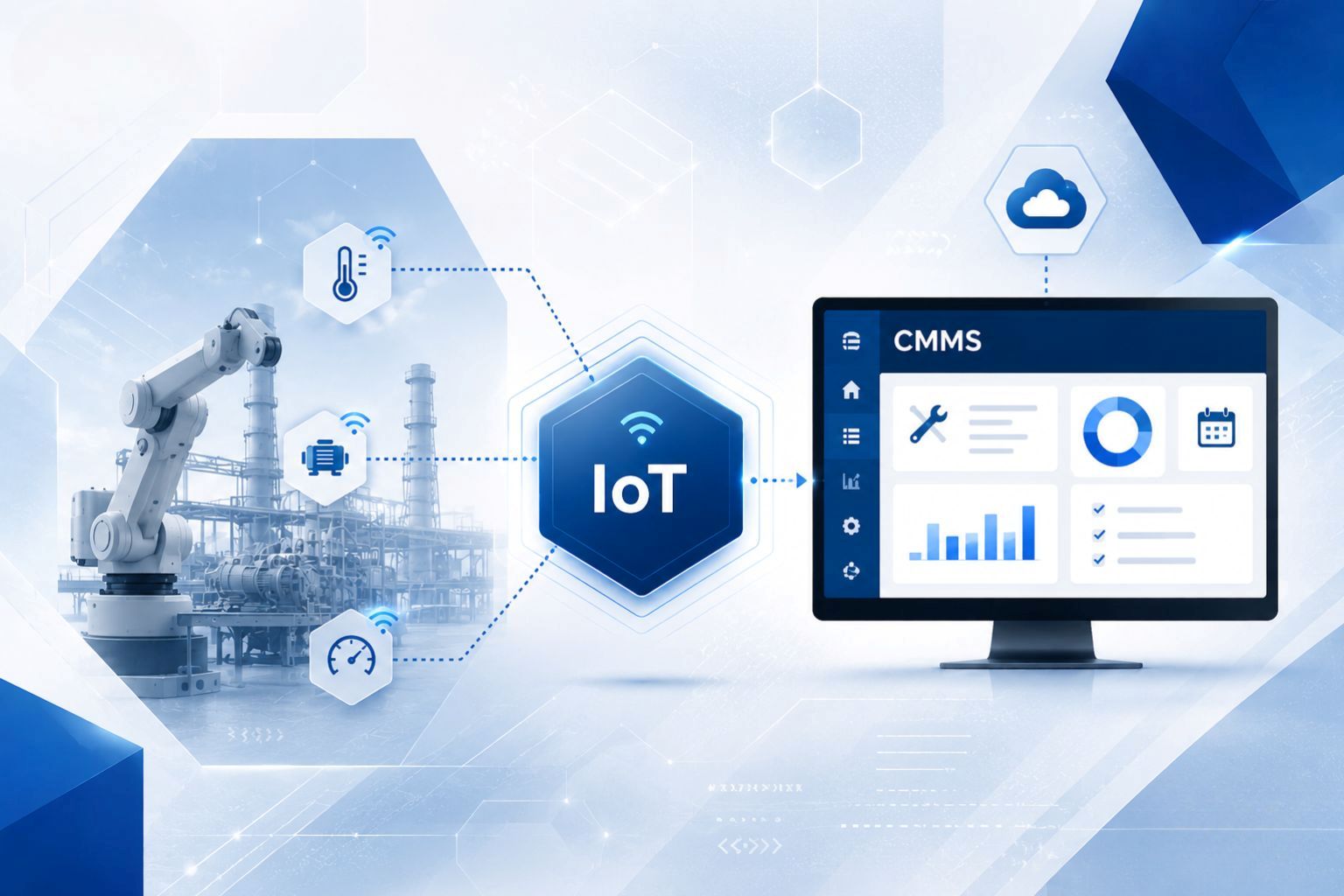
IoT × CMMS: How Smart O&M Outsourcing Reduces Equipment Costs by Up to 50% in Thailand
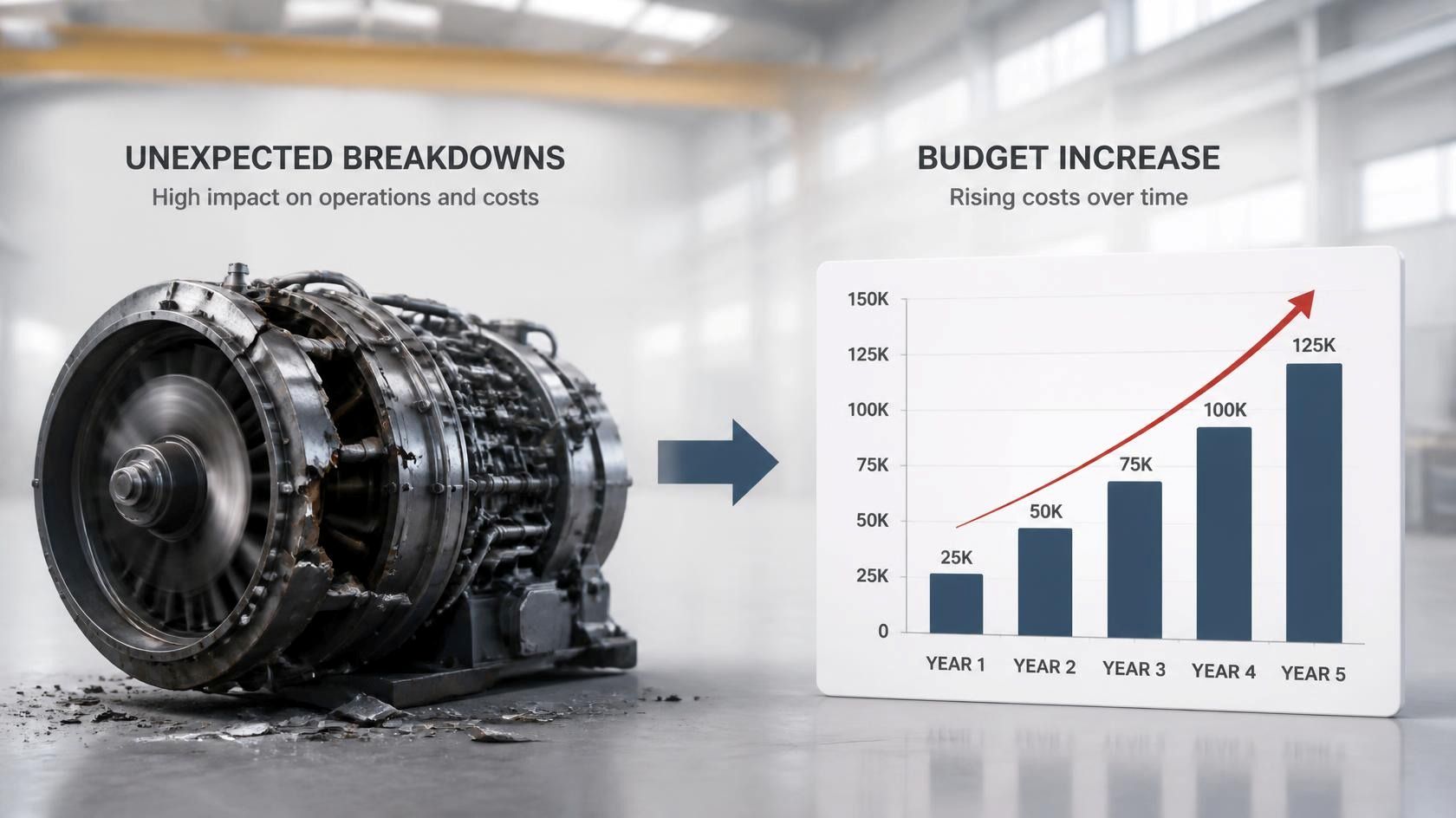
As industrial operations expand and equipment networks become more complex, relying on fixed-interval servicing or reactive maintenance is becoming less effective. Manufacturers are increasingly adopting IoT monitoring, CMMS platforms, and outsourced O&M services to support both condition-based and predictive maintenance.
By continuously monitoring equipment performance, IoT systems can identify abnormal conditions and predict potential failures before they occur. This allows maintenance teams to address issues proactively, reducing unplanned downtime, extending asset life, and lowering maintenance costs.
The Growing Equipment Management Crisis in Thai Manufacturing
Thai manufacturers are facing growing challenges in managing increasingly complex equipment networks. As production lines become more automated and skilled maintenance resources become harder to find, many factories struggle to maintain visibility over asset performance and prevent costly downtime.
This is not simply a maintenance resource issue—it's a visibility issue. By combining IoT sensors, CMMS platforms, and predictive maintenance analytics, outsourced O&M teams can continuously monitor equipment health, detect early warning signs, and predict potential failures before they occur. This helps factories reduce downtime, extend asset life, and lower maintenance costs
What Is O&M (Operations & Maintenance) Outsourcing?
O&M outsourcing means contracting equipment monitoring, maintenance planning, and technical response to a specialized third-party provider, rather than building and staffing that capability entirely in-house.
For Thai manufacturers, this typically covers:
- Routine inspection and preventive maintenance scheduling and execution
- Equipment monitoring via sensors and centralized software platforms
- Documentation and compliance reporting for energy use, equipment condition, and regulatory requirements
- Emergency response when equipment failures or anomalies occur
- Continuous improvement recommendations based on accumulated performance data across the client's equipment fleet
The strategic case for outsourcing isn't just cost — it's specialization and consistency. A dedicated O&M provider brings standardized processes, accumulated cross-client diagnostic experience, and software infrastructure (IoT sensors, CMMS platforms, centralized dashboards) that would be expensive and slow for an individual factory to build from scratch. It also removes the single-point-of-failure risk that comes from depending on one or two in-house technicians who hold all the institutional knowledge about a facility's equipment.
Importantly, outsourcing done well doesn't mean losing visibility — it means gaining more of it, through centralized monitoring systems that give factory management real-time access to equipment status rather than waiting for a monthly report.
Centralized Monitoring Explained: One Dashboard for All Your Equipment
The core architectural shift behind modern O&M is centralization. Instead of equipment status living in disconnected systems — one spreadsheet for compressors, a separate logbook for chillers, a different technician's notes for the production line motors — centralized monitoring consolidates everything into a single platform.
A well-designed centralized monitoring dashboard typically shows:
- Real-time status of every monitored asset (running, idle, fault, offline)
- Historical trends for key parameters (temperature, vibration, current draw, runtime hours)
- Active alerts and their severity, ranked so the most urgent issues surface first
- Maintenance schedules and completion status across the entire equipment fleet
- Energy consumption tied to specific equipment or production lines
The value of centralization compounds as a factory's equipment count grows. A single chiller's vibration reading in isolation tells you very little. The same reading, viewed alongside that chiller's historical baseline, its sibling units' performance, and the ambient conditions logged by nearby sensors, tells you whether something is actually wrong — and how urgently it needs attention.
For multi-site operators, centralization extends further: one dashboard covering equipment across multiple factories or facilities, allowing a regional or group-level operations manager to compare performance and prioritize resources without visiting each site individually.
How IoT Sensors Feed Data Into a Centralized Monitoring Platform
IoT (Internet of Things) sensors are the data-collection layer that makes centralized monitoring possible. Rather than relying on a technician's periodic manual readings, sensors continuously capture operating data and transmit it — via wired or wireless networks — to the central platform.
Common sensor types deployed across Thai industrial facilities include:
- Vibration sensors on rotating equipment (motors, pumps, compressors) to detect bearing wear, misalignment, or imbalance before they cause failure.
- Temperature sensors on electrical panels, transformers, and mechanical equipment to flag overheating before it becomes a fire or failure risk.
- Current and power sensors to monitor electrical load, detect abnormal draw patterns, and feed energy consumption data into reporting systems.
- Pressure sensors on compressed air systems, hydraulic equipment, and process piping to detect leaks or blockages.
- Environmental sensors (humidity, dust, ambient temperature) particularly relevant in Thailand's climate, where heat and humidity accelerate equipment wear.
The data pipeline matters as much as the sensors themselves. Raw sensor readings need to be transmitted reliably (often via cellular, Wi-Fi, or industrial communication protocols like Modbus or RS485), aggregated without gaps, and presented in a form that a maintenance planner — not just a data scientist — can act on quickly. A centralized platform that can't reliably ingest data from mixed equipment brands and ages isn't actually centralized; it's just another disconnected system with a nicer interface.
CMMS Explained: Computerized Maintenance Management Systems
If IoT sensors are the eyes, a CMMS (Computerized Maintenance Management System) is the brain that turns sensor data and maintenance history into action.
A CMMS platform typically manages:
- Asset registry — a structured database of every piece of equipment, including specifications, installation date, and maintenance history.
- Work order generation and tracking — automatically creating maintenance tasks based on schedules, sensor-triggered alerts, or technician requests, and tracking them through to completion.
- Spare parts inventory — linking maintenance tasks to the parts they require, helping avoid both stockouts and over-ordering.
- Maintenance scheduling — calendar-based (for routine checks) and condition-based (triggered by sensor thresholds) scheduling logic working side by side.
- Historical reporting — a searchable record of every intervention performed on every asset, replacing the tribal-knowledge risk described in Section 1.
The combination of IoT and CMMS is what separates modern O&M outsourcing from older maintenance contracts. IoT sensors detect the early signs of a developing problem; the CMMS automatically converts that signal into a scheduled, tracked work order, assigned to the right technician with the right parts — without requiring someone to notice the problem manually and create the paperwork by hand.
Preventive vs. Reactive Maintenance: The Cost Difference
The financial logic behind IoT-enabled CMMS-driven maintenance comes down to a simple, well-documented pattern: fixing equipment before it fails costs a fraction of fixing it after.
Reactive maintenance — responding only when equipment breaks down — carries hidden costs beyond the repair itself:
- Production downtime during the failure and repair window
- Rush-order parts pricing, since there's no lead time to source components at standard cost
- Secondary damage, since a failed component (a bearing, a seal) often damages adjacent parts before it's noticed
- Overtime labor costs for emergency response outside normal working hours
Preventive maintenance — scheduled intervention based on time intervals or, more precisely, on condition data from sensors — addresses components before failure, during planned downtime windows, with parts ordered in advance at standard pricing.
The cost differential is well-established across industrial maintenance literature and is consistent with what centralized, sensor-driven O&M programs report in practice: a properly implemented preventive and condition-based maintenance program can reduce overall failure-related costs by a wide margin compared to a purely reactive approach — which is the foundation for the 15–50% figure referenced in Section 11.
The key enabler is data: preventive maintenance without sensor data is just calendar-based guessing, which still wastes resources servicing equipment that didn't need it while missing equipment that's degrading faster than the calendar assumed. Condition-based maintenance, fed by IoT data into a centralized CMMS, replaces the guess with evidence.
Automated Reporting: Eliminating Paper-Based Records
Paper logs and manually compiled spreadsheets remain common in Thai industrial facilities, despite their well-known drawbacks: they're slow to compile, easy to lose, inconsistent between technicians, and nearly impossible to search or analyze for trends.
A centralized monitoring and CMMS platform automates this reporting layer entirely:
- Digital work order completion, with timestamps, technician notes, and photo documentation captured directly on a mobile device at the point of service.
- Automated compliance reports, generated on a schedule for regulatory submissions or internal management review, pulling directly from the same data used for day-to-day monitoring.
- Audit-ready history, since every maintenance action and every sensor reading is logged and retrievable, rather than depending on whether someone remembered to write it down.
For factory management, the practical benefit is time. A report that used to take a maintenance coordinator a full day to compile from scattered paper records can be generated from the centralized platform in minutes — and it's more accurate, because it's built from the same primary data the monitoring system already collected.
Centralized Energy Monitoring and CO2 Emission Tracking
The same sensor and platform infrastructure built for equipment health monitoring is directly reusable for energy and emissions tracking — a connection that's increasingly valuable as Thai manufacturers face growing carbon disclosure pressure (see our separate roadmap on carbon neutrality for Thai factories for the regulatory context).
A centralized energy monitoring layer typically tracks:
- kWh consumption by equipment, line, or facility, identifying which assets are the largest contributors to the electricity bill
- Power quality metrics (power factor, harmonic distortion) that affect both cost and equipment lifespan
- CO2 emissions calculated from consumption data, using Thailand's grid emission factor, converted automatically rather than requiring a manual annual calculation
- Trend analysis, flagging when a piece of equipment's energy consumption per unit of output is drifting upward — often an early sign of mechanical inefficiency before it shows up as an outright failure
This is one of the clearest examples of why centralization matters operationally, not just administratively: equipment health data and energy data are not separate concerns. A motor drawing more current than its historical baseline is both a maintenance signal and an energy cost signal at the same time, and a centralized platform surfaces both from a single data point rather than requiring two separate monitoring systems to each catch half the story.
24/7 Centralized Alert Service: Catching Problems Before They Cause Downtime
Equipment doesn't fail on a convenient schedule. A centralized monitoring platform's alerting layer is what turns continuous sensor data into actionable, round-the-clock protection.
Effective alerting includes:
- Threshold-based alerts, triggered when a reading (temperature, vibration, current) crosses a predefined safe operating limit
- Trend-based alerts, flagging gradual drift toward a threshold even before it's actually crossed — giving more lead time than a simple threshold trigger alone
- Severity tiering, so a minor deviation generates a routine work order while a critical reading triggers an immediate notification to on-call staff
- Multi-channel notification, reaching the right responder via app, SMS, or call depending on urgency, regardless of time of day
The 24/7 nature of this service matters particularly for facilities running multiple shifts or continuous processes, where a fault occurring at 3 a.m. on a weekend needs the same response speed as one occurring at 10 a.m. on a Tuesday. A centralized alert system staffed appropriately removes the dependency on whichever technician happens to be on-site noticing a problem visually or audibly — which, by definition, is often too late.
Emergency Response: Remote Diagnostics and On-Site Dispatch
When an alert does indicate a genuine problem, response speed and accuracy determine how much downtime actually results.
A mature centralized O&M model handles this in two stages:
- Remote diagnostics first — using the centralized platform's historical and real-time data, a remote technician can often diagnose the likely cause of an issue before anyone travels to site, narrowing down whether it's a sensor fault, a minor adjustable parameter, or a genuine mechanical failure requiring physical intervention.
- Targeted on-site dispatch — when physical intervention is needed, the dispatched technician arrives already knowing the probable cause, the relevant equipment history, and the likely parts required — rather than starting the diagnostic process cold at the equipment itself.
This sequencing meaningfully reduces both response time and the number of unnecessary site visits, since a portion of alerts can be resolved or downgraded remotely without ever requiring a technician to physically travel to the facility — a particular advantage for factories in industrial zones outside major urban centers where technician travel time can otherwise eat significantly into total response time.
Measurable Results: 15–50% Failure Cost Reduction Through Centralized Monitoring
The combined effect of IoT sensing, CMMS-driven maintenance planning, centralized monitoring, and rapid response is a documented reduction in failure-related costs ranging from 15% to 50%, depending on the facility's starting point and the equipment categories involved. Facilities moving from a largely reactive, paper-based maintenance model tend to see results at the higher end of that range, since the baseline inefficiency being corrected is larger.
The mechanism behind these savings is consistent across cases:
- Fewer unplanned production stoppages, since developing faults are caught and scheduled for repair before they cause an outright failure
- Lower emergency labor and rush-parts costs, since more interventions happen during planned maintenance windows rather than as emergencies
- Extended equipment lifespan, since condition-based maintenance addresses wear before it cascades into secondary component damage
- Reduced administrative overhead, since automated reporting (Section 7) removes hours of manual compilation work from maintenance staff
For Thai manufacturers considering O&M outsourcing, the key difference is centralized monitoring. Providers that only send technicians for scheduled visits still rely on a reactive model, without fixing the core visibility problem.
ELMO TECH uses a centralized approach that combines IoT sensors, CMMS work orders, and 24/7 monitoring in one platform. This enables fleet-wide oversight and measurable efficiency gains, with reported savings of 246 million kWh and 861 million THB to date
Blog
Our Latest Contents
Check out the latest news from the engineering industry, innovative implementations, and technical developments.
Explore how IoT and CMMS-powered smart O&M outsourcing can reduce equipment costs by up to 50% for factories in Thailand.
See how combining solar PV with battery storage helps Thai factories cut electricity costs beyond what rooftop solar alone can achieve.
Discover ISO9001-certified engineering, procurement, and construction (EPC) solutions built for Thailand's manufacturing industry.