Power Outage Protection for Thai Factories: How Solar Battery Storage Keeps Production Running
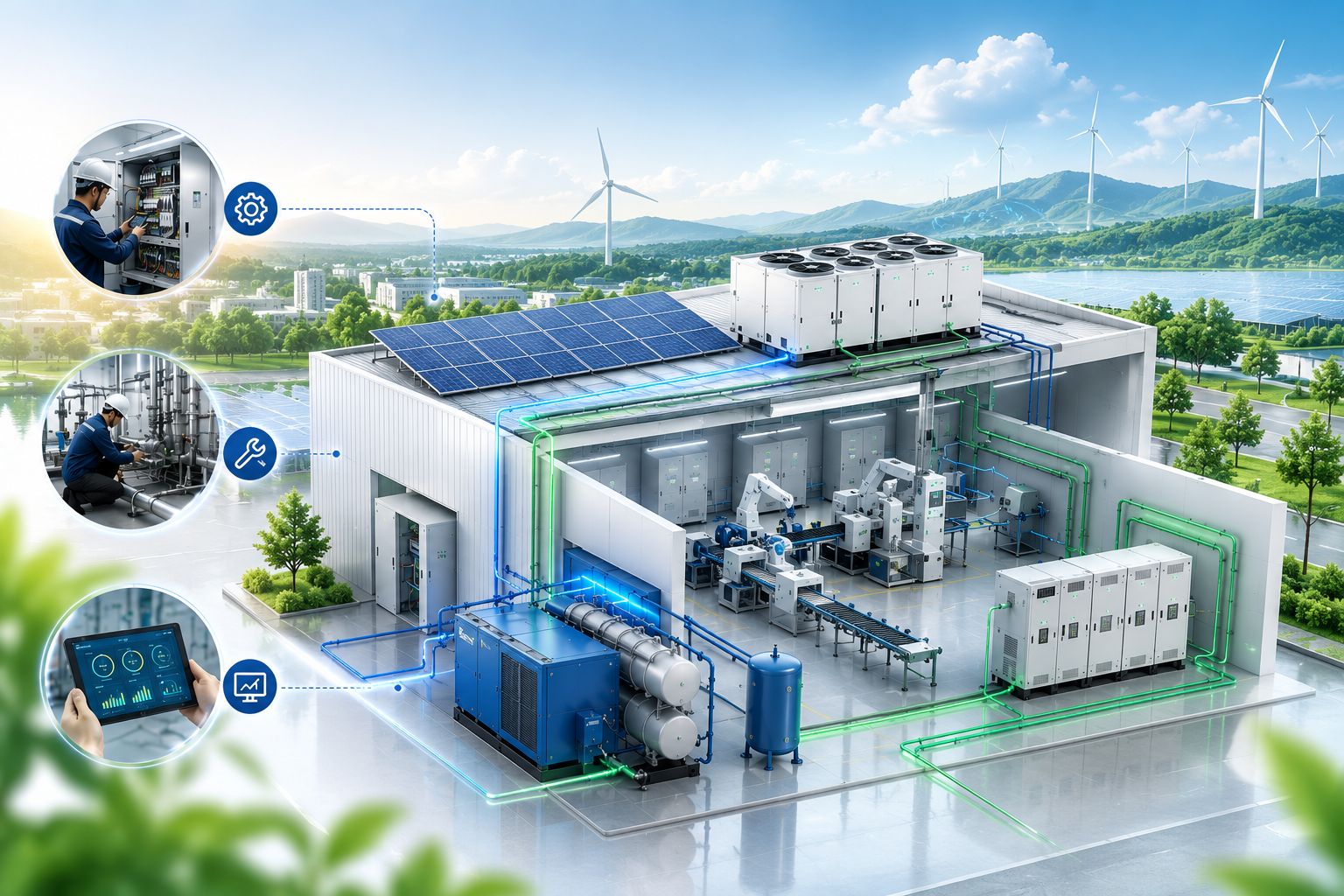
Thailand’s manufacturing sector depends on one critical assumption: electrical power is stable, continuous, and predictable. But in reality, that assumption is becoming increasingly fragile. Aging transmission infrastructure, rising peak demand from industrial expansion, weather volatility, and regional grid constraints are all contributing to more frequent and more costly disruptions.
For factory operators, the impact is not theoretical. Even a few seconds of interruption can stop production lines, corrupt process data, damage sensitive equipment, or trigger full system restarts that take hours to recover. In high-throughput environments, downtime quickly translates into financial loss, supply chain delays, and quality risks.
This article explores the real operational impact of outages, compares traditional backup systems with modern battery energy storage systems (BESS), and explains how solar-plus-storage architecture is reshaping energy resilience for industrial facilities in Thailand.
How Power Outages Cost Thai Manufacturers Millions
Power interruptions are not minor operational disturbances in industrial environments—they are high-impact financial events.
Globally, the economic burden of grid instability is well documented. In regions with severe instability, cumulative outage durations can reach hundreds or even thousands of hours annually, translating into billions in lost productivity. Even short, localized disruptions can ripple across supply chains when factories operate under just-in-time production systems.
For Thai manufacturers, the exposure is similar, especially in sectors such as food processing, electronics, automotive parts, and cold chain logistics. The costs of outages typically fall into five major categories:
- Production downtime: Every minute of halted production represents lost output that cannot always be recovered through overtime or extended shifts.
- Product spoilage: Cold storage and temperature-controlled environments may experience irreversible losses within hours.
- Restart inefficiency: Industrial processes often require controlled shutdown and restart sequences that consume significant energy and time.
- Equipment stress and failure: Voltage fluctuations during outages or grid recovery can damage sensitive electronics, drives, and control systems.
- Safety risks: Critical systems such as ventilation, alarms, and automated safety controls may temporarily fail.
A key issue is that most factories underestimate their true exposure. Without detailed load analysis, the real cost per outage event is often significantly higher than expected.
Traditional Backup Generators vs. Modern Battery Storage: A Comparison
Diesel generators have long been the default backup solution for industrial facilities in Thailand. They are reliable in the mechanical sense but increasingly misaligned with modern energy and operational requirements.
Battery Energy Storage Systems (BESS), particularly when paired with solar PV, introduce a fundamentally different operating model.
The key shift is functional: generators are idle assets that activate only during emergencies, while battery systems are active energy assets that continuously optimize electricity costs, peak demand charges, and grid stability.
This dual-use capability significantly improves return on investment and shortens payback periods, especially in facilities with high daytime energy consumption.
How a Battery Storage System Functions as Emergency Power Supply
A modern C&I battery storage system consists of three core components:
- Battery modules – Store energy in DC form
- Battery Management System (BMS) – Controls charging, discharging, and thermal safety
- Hybrid inverter / PCS – Converts DC to AC and synchronizes with grid or load
During normal operation, the system performs multiple roles: peak shaving, solar self-consumption optimization, and load balancing.
When a grid disturbance occurs, the system reacts automatically. The most critical performance factor is switching speed. Advanced systems can transition from grid to battery supply so quickly that connected equipment experiences no interruption at all.
This is important because many industrial systems have very low tolerance for voltage gaps. Even 10–20 milliseconds of interruption can reset PLC controllers, disrupt production logic, or trigger fault states in automation systems.
Modern systems are designed to operate below this threshold, effectively making the transition electrically invisible to downstream loads.
Which Equipment Should Be Prioritized During an Outage?
Not all loads in a factory require equal protection. Proper segmentation is essential for cost-efficient system design.
Tier 1 – Mission-critical loads
- PLC/SCADA systems and industrial controllers
- Safety systems and emergency controls
- Cold storage and refrigeration systems
Tier 2 – Production-critical loads
- Conveyor systems and production motors
- Pumps, compressors, and process equipment
- CNC and precision manufacturing machines
Tier 3 – Non-critical loads
- Office lighting and HVAC
- Administrative systems
- Auxiliary equipment
One of the most important technical considerations is motor inrush current. Many industrial machines require 3–7 times their rated power at startup. If the backup system cannot handle this surge, the equipment will fail to restart even if sufficient total energy is available.
This is why inverter overload capability is often more important than total battery capacity. Systems must be able to temporarily exceed rated output to handle these short but intense demand spikes.
Real-Time Monitoring: Detecting Grid Instability Before It Hits
Modern energy systems are not passive—they actively monitor grid conditions in real time.
Key parameters include:
- Voltage deviation
- Frequency drift
- Harmonic distortion
- Phase imbalance
When early warning signs appear, the system can pre-charge response circuits and prepare for seamless transition. This reduces both mechanical stress and operational disruption.
Cloud-based monitoring platforms extend this capability further by allowing centralized visibility across multiple facilities. Facility managers can track system health, battery state-of-charge, fault logs, and energy flows in real time.
Advanced systems also integrate AI-assisted fault detection, which identifies abnormal electrical signatures that may indicate arc faults or insulation degradation before they escalate into failures or fire risks.
Frequency Adjustment and Power Stabilization Explained
Grid stability is not only about keeping power on—it is also about maintaining consistent frequency and voltage quality.
In Thailand, grid frequency is nominally 50Hz, but small fluctuations are common under load stress. Sensitive industrial equipment can react negatively to these deviations.
Battery systems contribute to stability in two key ways:
- Fast frequency response:
They inject or absorb power within milliseconds to stabilize grid fluctuations. - Voltage regulation:
They correct dips and spikes that may affect sensitive machinery.
Additionally, modern systems can automatically detect phase issues during installation, reducing commissioning time and minimizing human error.
For precision industries, this stability layer can be as valuable as backup power itself.
Case Study: Maintaining Production Through a Grid Failure
In one European industrial deployment, a mid-sized manufacturing facility installed a 440 kW hybrid inverter system paired with over 1 MWh of modular battery storage.
The primary goal was not just backup power, but energy optimization under variable tariffs. However, the system also provided critical continuity during unexpected grid fluctuations.
The modular architecture allowed installation in constrained industrial space without major structural modification. Instead of building new infrastructure, the system was integrated into existing facility layouts.
A similar deployment in Asia combined solar PV with battery storage in a DC-coupled architecture, enabling higher efficiency and greater solar self-consumption.
Across both cases, the key success factor was scalability—systems were expanded incrementally as demand grew rather than requiring full upfront over-sizing.
Combining Solar and Battery Storage for Total Energy Independence
Thailand’s solar potential is strong, particularly for industrial rooftops that receive consistent daylight exposure.
When solar PV is combined with battery storage, the system achieves both generation and reliability. Without storage, solar alone cannot provide backup power during outages due to anti-islanding safety requirements.
A DC-coupled architecture improves efficiency by reducing conversion losses. Instead of converting DC → AC → DC, energy flows more directly through the system.
Benefits include:
- Higher round-trip efficiency
- Reduced equipment count
- Lower maintenance complexity
- Improved expansion flexibility
Over time, these efficiency gains translate into measurable reductions in operational energy costs.
Sizing Your Storage System for Outage Protection: Key Considerations
Proper system sizing is one of the most critical design steps.
Key factors include:
Load analysis
Understanding actual consumption patterns rather than relying on nameplate ratings.
Outage duration target
Defining whether the system is intended for seconds, minutes, or hours of backup.
Surge capability
Ensuring the system can handle motor starting currents and transient spikes.
Modularity
Allowing future expansion without system redesign.
Integration with solar
Determining whether DC or AC coupling provides better lifecycle economics.
Many systems fail not because of poor technology, but because of incorrect sizing assumptions made at the design stage.
Maintenance and Testing: Keeping Your Backup System Ready
A backup system must be continuously verified to ensure readiness.
Key reliability factors include:
- Environmental protection (IP rating): Industrial environments require dust and water resistance for long-term stability.
- Battery balancing systems: Prevent capacity drift between cells and extend usable lifespan.
- Thermal safety design: Early detection of abnormal heat buildup improves safety margins.
- Routine testing: Automatic transfer tests and system diagnostics ensure readiness under real conditions.
Modern systems increasingly support remote diagnostics, reducing the need for on-site inspections and improving operational efficiency.
Summary
Power reliability is no longer a secondary engineering consideration—it is a core operational requirement for modern manufacturing competitiveness.
As Thailand’s industrial sector continues to expand, energy resilience will increasingly determine production stability, cost efficiency, and risk exposure.
Solar-plus-storage systems represent a shift from passive backup to active energy management. Instead of simply reacting to outages, facilities can now stabilize, optimize, and reduce energy costs continuously while maintaining full backup capability.
For manufacturers evaluating energy resilience, the most important step is not selecting equipment—it is understanding actual load behavior through proper site assessment and system design.
Blog
Our Latest Contents
Check out the latest news from the engineering industry, innovative implementations, and technical developments.
Learn how solar-plus-battery storage protects Thai factories from power outages and keeps production running without interruption.
A practical framework to help factory managers decide whether to upgrade existing equipment or replace it, plus a real 19% cost-reduction example.
Explore how IoT and CMMS-powered smart O&M outsourcing can reduce equipment costs by up to 50% for factories in Thailand.