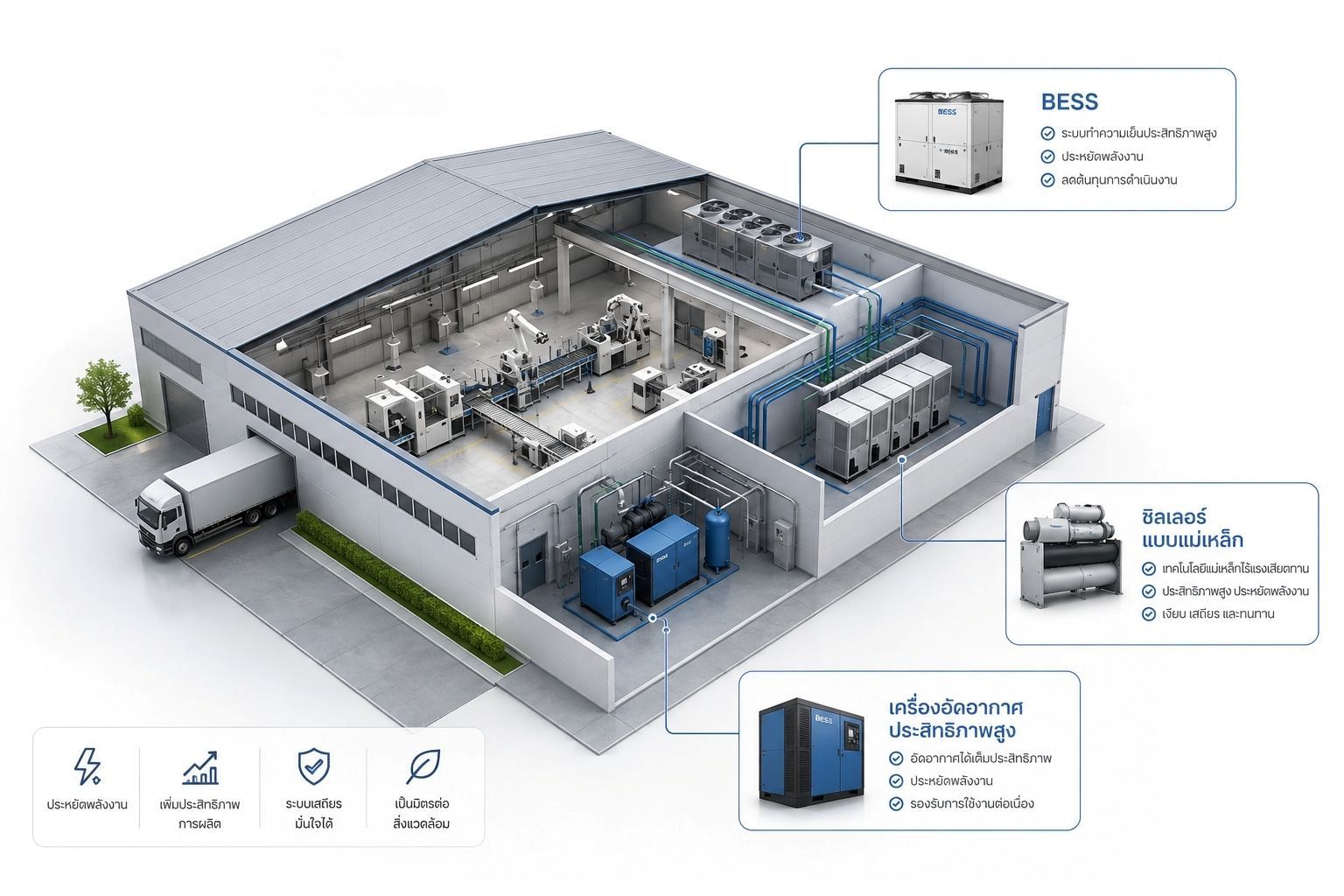
Carbon Neutrality for Thai Factories: A Practical Roadmap Using Engineering & Energy Solutions
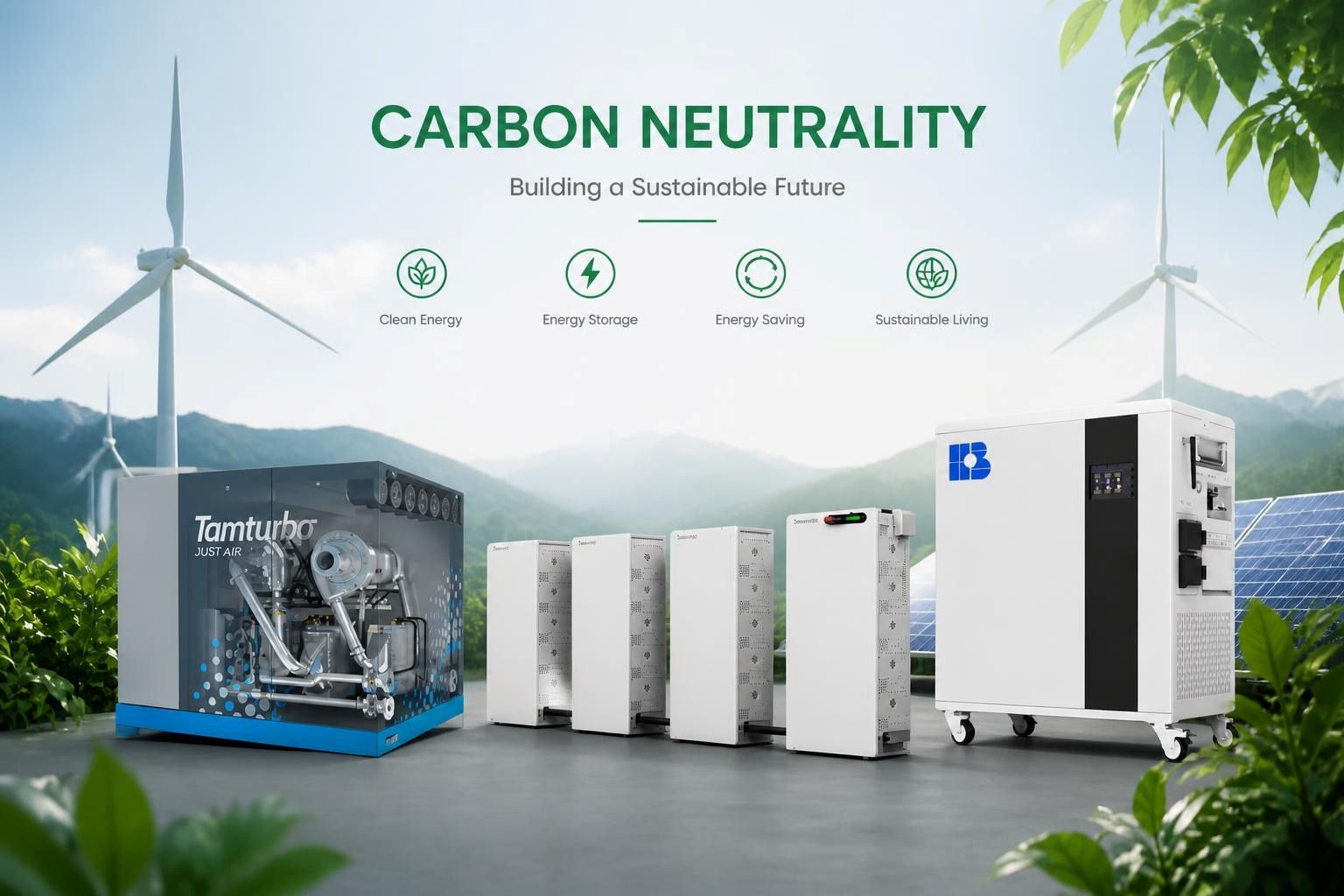
Carbon neutrality has shifted from a sustainability talking point to a procurement requirement. Thai factories pursuing carbon neutrality need more than intent — they need a practical engineering solution built around specific equipment, sequenced correctly, and verified with real data. This roadmap walks through exactly that: what equipment actually reduces CO2, in what order it should be deployed, and how to measure the result.
Why Carbon Neutrality Is Now a Business Priority in Thailand
Thai manufacturers exporting to the EU, US, and increasingly to regional supply chains are facing carbon disclosure requirements as a condition of doing business not a marketing add-on. Mechanisms like the EU's Carbon Border Adjustment Mechanism (CBAM) directly price imported carbon intensity for sectors such as steel, cement, and aluminum, with pressure spreading to suppliers in adjacent industries as buyers push reporting requirements down their supply chains.
Beyond compliance, there's a straightforward financial case for any Thai engineering solution aimed at carbon neutrality. Energy is one of the largest controllable cost lines in most factories, and the equipment that reduces emissions efficient motors, solar PV, battery storage, heat recovery systems is frequently the same equipment that reduces the electricity bill. Carbon reduction and cost reduction are, in most factory contexts, the same engineering project viewed from two different angles.
Thailand's grid still leans heavily on natural gas and coal generation, meaning every kW of demand a factory avoids drawing from the grid has a real, quantifiable emissions value not just a symbolic one. That makes carbon neutrality, for a factory, fundamentally an equipment and engineering problem rather than a reporting exercise.
Thailand's Environmental Regulations: What Manufacturers Must Know
Thai factories operate under a layered and steadily tightening regulatory environment:
- Ministry of Industry / Department of Industrial Works (DIW) requirements covering energy reporting for designated factories, particularly larger energy-consuming facilities.
- Energy Conservation and Promotion Act, which mandates energy audits and conservation measures for "designated facilities" above defined consumption thresholds.
- Thailand's Nationally Determined Contribution (NDC) under the Paris Agreement, which filters down into sector-level targets and incentive programs, including BOI tax incentives tied to energy-efficiency and renewable energy investment.
- Thailand Greenhouse Gas Management Organization (TGO) carbon credit and labeling schemes, including the T-VER (Thailand Voluntary Emission Reduction) program, which allows verified emissions reductions to be registered and monetized.
For export-oriented manufacturers, customer-driven requirements — Scope 3 reporting requests from multinational buyers are often arriving faster and with more specificity than domestic regulation. A practical engineering solution treats domestic regulatory minimums as the floor, not the target, since customer expectations are typically the binding constraint.
Assessing Your Factory's Current Carbon Footprint
You cannot engineer a reduction in what you haven't measured. A proper baseline assessment covers three scopes:
- Scope 1 — direct emissions from on-site fuel combustion (boilers, generators, process heat)
- Scope 2 — indirect emissions from purchased electricity, calculated using Thailand's grid emission factor
- Scope 3 (where relevant) — upstream and downstream emissions, including raw material transport and product distribution
The audit process typically involves:
- Utility bill and meter data analysis — 12+ months of electricity, fuel, and water consumption to establish seasonal patterns and baseline kWh per unit of production.
- Equipment-level metering — sub-metering major loads (compressed air, chillers, motors, lighting) to identify where consumption is actually concentrated.
- Thermal and electrical surveys — infrared thermography to detect insulation losses, and power quality analysis to identify inefficiencies in motor drives and electrical distribution.
- Carbon factor calculation — converting consumption data into tCO2e using current Thai grid emission factors and fuel-specific coefficients.
The output should be a ranked list of interventions by reduction-per-Baht-invested, not a generic checklist. This ranking is what should drive the equipment sequencing in the sections that follow and it's the single biggest determinant of whether a carbon neutrality project delivers real engineering value or just expensive optics.
High-Efficiency Motors, VSDs & Power Quality Equipment: Cutting kW Demand at the Source
Before adding generation capacity, the highest-return engineering intervention is almost always reducing kW demand at the equipment level. This is where most carbon neutrality roadmaps should start, because it shrinks the size and cost of every solar and storage system designed afterward.
High-efficiency motors (IE3/IE4 class) replacing older standard-efficiency motors on pumps, fans, and compressors typically deliver 3–8% efficiency gains, often with payback periods under three years.
Variable speed drives (VSDs) match motor output to actual demand rather than running fixed-speed motors at full output regardless of load a particularly large opportunity on pumps, fans, and compressors that rarely operate at constant full capacity.
Power quality equipment: power factor correction units and harmonic filters reduces reactive power penalties, lowers transmission losses, and reduces electrical stress that shortens equipment life. These are frequently overlooked in carbon planning because their CO2 impact is indirect, but poor power quality means a factory is drawing more kW from the grid than its actual productive load requires.
Combined, these three equipment categories reduce the baseline kW draw a factory needs to cover directly lowering Scope 2 emissions before a single solar panel is installed.
LED Lighting, Compressed Air & Heat Recovery: Low-Cost Equipment for High-Impact CO2 Reduction
A second tier of equipment delivers high CO2 reduction relative to cost, making it ideal for the early phases of an engineering roadmap.
LED lighting retrofits typically cut lighting energy consumption by 50–70% compared to fluorescent or metal halide fixtures, with the added benefit of longer service life and reduced maintenance frequency fewer replacement cycles also means fewer disposed fixtures and less embedded carbon from manufacturing replacements.
Compressed air system optimization addresses one of the most consistently wasteful utilities in Thai factories. Leak detection and repair, right-sizing compressors to actual demand, and pressure optimization commonly recover 20–30% of generated compressed air volume that would otherwise leak away as pure energy waste.
Heat recovery systems capture waste heat from compressors, furnaces, or chillers and redirect it to process heating or hot water needs, displacing fuel or electric heating that would otherwise be required elsewhere in the plant converting what was previously a pure loss into usable thermal energy.
These equipment categories share a common trait: they tend to have the shortest payback periods of any item on this roadmap, making them the easiest to justify internally and the right starting point before committing capital to larger generation and storage systems.
Solar PV Systems: Sizing Clean Generation to Your Factory's Load
Once demand-side equipment has reduced the baseline load, the next engineering layer is clean generation and solar PV is the most accessible option for most Thai factory rooftops.
Sizing solar correctly requires matching generation capacity to the audited load profile from Section 3, not simply maximizing roof coverage. Key equipment considerations:
- Modular hybrid inverters, available in incremental capacities (commonly 50kW, 60kW, 80kW, 100kW, 110kW, and 125kW per unit), allow PV systems to be sized precisely to available roof area and load rather than forcing a factory into oversized or undersized fixed inverter steps.
- Wide MPPT voltage range — some advanced inverters operate down to 160V versus 200V on older designs — extends generation hours at the start and end of each day, capturing more usable solar energy from the same panel area.
- DC/AC oversizing ratio up to 2.0 allows more PV capacity to be installed without inverter clipping losses, provided the system has storage capacity (Section 7) to absorb the surplus DC power that would otherwise be wasted.
For a factory with substantial daytime load — most manufacturing operations solar PV converts a meaningful share of Scope 2 grid-electricity emissions into on-site clean generation, with payback periods that have become increasingly favorable as panel and inverter costs have declined.
Battery Energy Storage (BESS): Equipment That Turns Solar Into 24/7 Clean Power
Solar alone only generates during daylight hours. Battery storage is the equipment layer that extends solar's emissions benefit into evening shifts, night production, and grid-outage periods converting a partial daytime offset into a much larger share of total facility consumption covered by clean energy.
Key equipment characteristics that matter for a carbon-focused engineering deployment:
- Modular, stackable battery units — commonly built from individual modules in the 12kWh range, combined into stacked systems of 253kWh or more — allow storage capacity to scale alongside solar capacity without requiring a full system redesign as the factory's needs grow.
- DC-coupled architecture, where PV and battery share a single hybrid inverter, improves round-trip efficiency to approximately 91%, compared to roughly 89% for traditional AC-coupled retrofit systems. That efficiency gain compounds over the system's operating life into additional usable clean energy from the same generation capacity.
- Battery-ready inverters with reserved battery ports allow factories to install solar now and add storage later without replacing existing inverter hardware — a useful sequencing option for facilities phasing capital investment across budget cycles.
Together, solar and storage form the centerpiece of most factory decarbonization roadmaps, but their cost-effectiveness depends entirely on whether Sections 4 and 5 have already reduced the load they need to cover.
Cloud-Based EMS & Monitoring Equipment for Real-Time Emissions Tracking
Equipment delivers CO2 reduction only as long as it's verified to be performing as designed, which requires a monitoring layer, not just installed hardware.
A cloud-based Energy Management System (EMS) typically provides:
- Real-time generation and consumption data, converting raw kWh figures into emissions-avoided calculations continuously rather than through annual estimation.
- Remote EMS capability, allowing facility managers or multi-site operators to monitor and adjust energy strategy (self-consumption mode, dynamic tariff participation, peak-shaving) from a central dashboard rather than requiring on-site intervention.
- AI-assisted optimization, adjusting battery charge and discharge timing based on real-time tariff signals; in one documented deployment in Poland, this kind of optimization reduced average grid electricity cost per kWh by 48% across a single seasonal transition, purely through smarter timing rather than any hardware change.
This monitoring layer is also what makes external carbon reporting credible. Auditors, certification bodies, and corporate customers increasingly expect metered, time-stamped generation and consumption data rather than estimated annual figures making the EMS as much a compliance tool as an operational one.
How ISO 9001-Certified Construction Ensures Equipment Performs as Designed
Equipment specifications only deliver their rated CO2 reduction if installation quality matches the engineering design. ISO 9001:2015 certification governs this at the process level, covering:
- Design review and engineering sign-off before procurement, ensuring system sizing matches the audited load profile from Section 3 rather than a generic template.
- Procurement quality control, verifying equipment specifications and certifications match project requirements before installation begins.
- Installation and commissioning protocols, including documented cold and hot commissioning testing before a system is handed over for operational use.
- Continuous improvement processes, requiring documented corrective action whenever installed performance deviates from design targets.
For carbon-focused projects specifically, this matters because underperforming equipment doesn't just waste capital — it produces a measurable emissions shortfall against whatever reduction figure was reported to regulators, customers, or financing partners. Quality assurance at the construction stage functions as an integrity control on the carbon numbers themselves, not just a project management formality.
Working With ELMO TECH: From Equipment Audit to Measurable CO2 Reduction
ELMO TECH, established in 2009 and ISO 9001:2015 certified, operates as a single accountable engineering partner across the full project lifecycle — engineering, procurement, and construction (EPC) — rather than handing a factory off between separate audit, equipment supply, and installation vendors.
The practical workflow follows the sequence laid out in this roadmap:
- Site audit and baseline assessment — utility data review, equipment-level metering, and thermal/electrical surveys (Section 3).
- Engineering design — sizing demand-side equipment, solar PV, and battery storage against the actual audited load profile, not a standard template.
- Procurement — sourcing equipment with verified specifications suited to Thailand's operating environment (heat, humidity, dust).
- Construction and commissioning — installation under documented ISO 9001 quality protocols, with cold and hot commissioning testing before handover.
- Ongoing monitoring — cloud-based EMS tracking to confirm the system keeps delivering its designed CO2 reduction over its operating life, not just at the moment of handover.
Across past projects, this approach has delivered over 246 million kWh in documented consumption reduction and approximately 861 million THB in cumulative client savings figures that translate directly into avoided carbon emissions, since every kW of demand removed or shifted to clean generation carries a quantifiable reduction against Thailand's grid emission factor.
Carbon neutrality, approached this way, isn't a certificate a factory earns once. It's an engineering outcome built from the right equipment, installed correctly, sequenced in the right order, and verified continuously — starting with the demand-side equipment that pays for itself fastest, and scaling toward generation and storage as that foundation is laid
Blog
Our Latest Contents
Check out the latest news from the engineering industry, innovative implementations, and technical developments.
A practical roadmap showing which equipment actually cuts CO2 for Thai factories pursuing carbon neutrality, in the right sequence.
Learn how solar-plus-battery storage protects Thai factories from power outages and keeps production running without interruption.
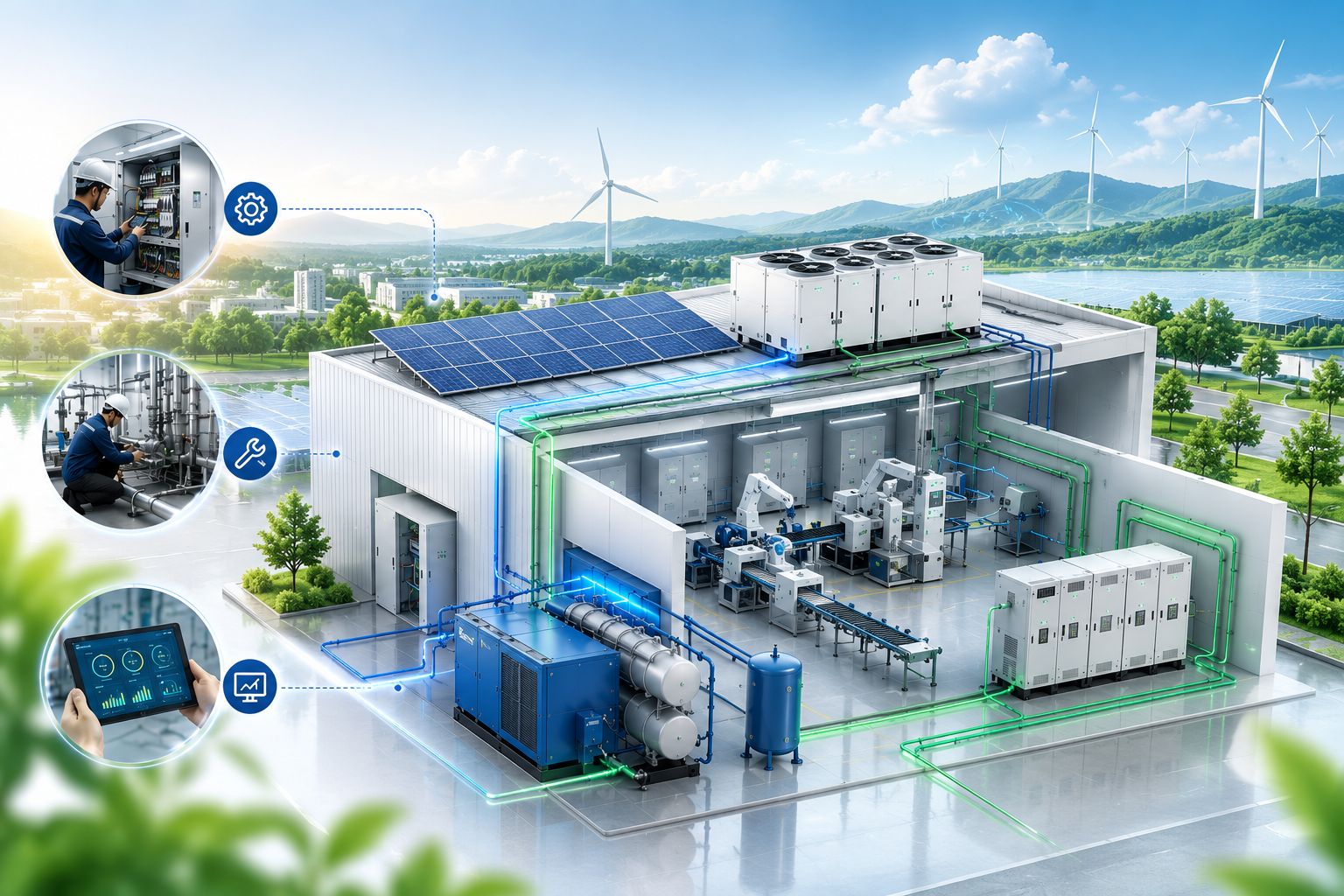
A practical framework to help factory managers decide whether to upgrade existing equipment or replace it, plus a real 19% cost-reduction example.