BESS operation and maintenance issues. What is the strategy for Japanese companies to succeed in Thailand?
.jpg)
Power issues faced by companies expanding into Thailand and solutions called BESS
As Japanese companies expand into Thailand at an accelerated pace, one of the biggest challenges they face locally is the “stable supply of electricity.” Power outages can occur from a few times a year to 2 to 3 times a week depending on the region. Production line stopped due to instantaneous voltage drop. There are many Japanese companies that are worried about these issues.
Meanwhile, battery energy storage systems (BESS) are attracting attention. Implementation is progressing rapidly as a strategic capital investment that goes beyond simple backup power sources to reduce electricity costs and even realize effective use of renewable energy.
The Thai government is also in 202410,000 MW deployment planIt was announced. It can be said that right now is the perfect time to consider implementation. However, there are many issues to be overcome, such as a hot and humid environment different from Japan, unique regulations, and the construction of a local operation and maintenance system.
In this article, I will explain practical points when introducing and operating BESS in Thailand, with the latest case studies and data.
Basic configuration of BESS and operational points in Southeast Asia
What is BESS in the first place?
BESS can be broadly divided into 4 elements.
- Battery body(cell module pack)
- Power conversion systems (PCS): Converts DC and AC
- cooling system: Battery temperature management
- Battery Management Systems (BMS): Overall control and monitoring
Of these, the “cooling system” is particularly important in Thailand.
Technical points that should be kept in hot and humid ties
The average annual temperature in Thailand is 28-35°C, and the humidity is 70-90%. The impact of this environment on batteries is greater than you can imagine.
Actually, lithium-ion batteriesLife is halved when the temperature rises by 8°CIt's going to become. It is calculated that a battery that can be used for 10 years in a 25°C environment in Japan will only last 5 years in Thailand's 33°C environment.
Therefore, the choice of cooling technology becomes important. In the latest projectliquid cooling systemThe adoption of has become mainstream, and it is now possible to control temperature more efficiently than air cooling.
In demonstration tests carried out by Toyota and Siam Cement (SCC), interesting results have been achieved with a system that reuses used EV batteries.lithium iron phosphate (LFP) batteriesBy adopting it, a long life span of 3,000 cycles or more is achieved even in high temperature environments. This is a calculation that can be used for 8 years or more even when charged and discharged every day.
Practical know-how to avoid failure in daily operation and maintenance
A 24/7 monitoring system is essential
The most important part of BESS operation is “early detection of abnormalities.” Since power outages occur frequently, especially in Thailand, it is necessary to keep track of the state of the system at all times.
The main items to be monitored are as follows.
- temperatures: Constantly check the temperature of cells, modules, and cooling systems
- State of charge (SOC): Battery charge level
- Health (SOH): The degree of battery deterioration
In the latest system, after detecting an anomalyAuto shut off within 0.5 secondsA mechanism that can be used is standard equipment. This makes it possible to prevent major accidents before they occur.
Example schedule for regular inspections
The following hierarchical schedule is recommended for efficient maintenance.
Implemented every month
- Cleaning cooling fans and filters (especially important in dusty Thailand)
every 3 months
- Measurement of insulation resistance
- System log analysis
Once a year
- Temperature distribution check using thermography
- Firefighting equipment inspection
every 5 years
- Battery Cell Balancing
The key to longevity is “shallow cycle” operation
The easiest way to make your battery last longer is to use a 20 to 80 percent charge. This is called “shallow cycle operation.”
Rather than repeating full charging/full discharge, this method1.5 times longer lifeYou can extend it to It can ensure a useful life of 4,000 to 6,000 cycles, which is also advantageous in terms of return on investment.
Implementation strategies and economic analysis by application
How to use it in factories and manufacturing
Many implementation cases have already been created in the Thai manufacturing industry. For example, an auto parts factory implemented a 214MW distributed system and succeeded in reducing annual electricity costs by 20%.
There are three main purposes for introducing BESS in factories.
- Outage countermeasures: Ensure continuous operation of production lines
- peak cut: Reduce demand charges by leveling electricity usage
- Cooperation with solar power: Utilize surplus daytime electricity at night
The average operating and maintenance cost is**2 to 3% of the initial investment per year**. This also includes professional technician labor costs ($80 to $120 per hour).
The interesting thing isAI predictive maintenanceThis is an example of a company that has introduced it. There are reports that battery-related maintenance costs were reduced by 50% and inverter-related costs by 30%.
Advantages of implementation in commercial facilities
The adoption of “hybrid surveillance systems” is increasing in shopping malls and office buildings. By combining routine inspections by local staff with support from remote monitoring centers, high reliability can be ensured while keeping costs down.
In addition, it is also possible to earn additional income from electric power companies by participating in “demand response” utilizing a fee system for each time zone.
How long is the payback period?
Looking at the total cost for 15 years, the breakdown is as follows.
- Initial investment (CAPEX): 70— 75%
- Operation and maintenance (OPEX): 15— 20%
- Exchange/Renewal Fee: 10-15%
Cost comparison by technology (per kWh, 15 years)
- lithium iron phosphate (LFP): $730-870 (resistant to high temperature environments and long life)
- ternary system (NMC): $720-880 (higher energy density)
- lithium titanate (LTO): $800 to $980 (ultra-fast charge/discharge is possible)
If government support is used,Investment payback period is 2 to 5 yearsIt can be shortened to The power cost reduction effect is 10 to 30%, and sufficient economy can be expected.
How to deal with issues unique to Thailand
Responding to climatic conditions is essential
What you should pay particular attention to in the Thai climate is the rainy season from June to October. Since 80% of annual rainfall is concentrated during this period, waterproof and dustproof measures are essential.
Salt damage countermeasures are also important in coastal factories. It is necessary to select equipment with a protection level of IP67 or higher and incorporate regular salt removal work.
Responding to regulations and leveraging government support
When implementing BESS in Thailand, permission from the Energy Regulatory Commission (ERC) is required. A deposit of 1,000 baht per kW is required at the time of application, and an environmental impact assessment is also required.
Meanwhile, an attractive support system is also in place.
- BOI investment promotion: 8-year corporate tax exemption for high-density battery manufacturing
- FiT system: 25-year fixed price purchase with solar+BESS
- Direct PPA system: Direct electricity transactions between companies are possible
The Fire Service Act, which was revised in 2024, strengthened the installation standards for lithium-ion batteries. Since it is essential to install fire compartments and introduce foam fire extinguishing equipment, it is necessary to consider them from the design stage.
Operational innovation brought about by the latest technology
Towards an age where AI predicts breakdowns
According to the latest survey, companies that have introduced AI67% were successfulIt is stored. As a specific effect, the charging state estimation accuracy is compared to the conventional 85 to 88%Up to 96%. The speed of detecting abnormalities has also been drastically shortened from the conventional 15 to 20 seconds, to 2 seconds for voltage fluctuations and 3 seconds for temperature abnormalities.
Realizing “visualization” with digital twins
“Digital twin” technology, which constructs a digital model that performs the same movement as a physical BESS, is also attracting attention. This can be expected to have three effects: failure prediction, operation optimization, and safety improvement.
The latest measures to prevent thermal runaway accidents
From 2024 to 2025, large-scale accidents also occurred overseas. 1,200 people have been evacuated at Moss Landing in California. Based on these lessons, the importance of early detection systems has been reaffirmed.
Gas sensors for CO, methane, ethane, ethylene, etc. are installed to quickly detect abnormalities. A mechanism to prevent major accidents is being standardized by combining a 24-hour monitoring system and an automatic shut-off system.
How to choose a maintenance contract and optimize ROI
Economic benefits of predictive maintenance
Companies that have introduced predictive maintenance have reported the following results.
- An unplanned shutdown80% reduction
- The number of local dispatch times60% reduction
- Labor costs per year20-30% reduction
Optimizing temperature management alone can extend battery life by 15 to 20%, and can be expected to have an economic effect of 60 to 80 dollars per kWh.
Choose from 2 types of maintenance contracts
Full maintenance agreement(3-5% of initial investment per year)
- Benefits: comprehensive services, fixed costs, risk transfer
- Disadvantage: Higher cost
Individual Response Agreements(2-4% of initial investment per year)
- Advantages: high flexibility, low initial cost
- Disadvantage: Unforeseen costs may occur
The cost of implementing predictive maintenance services is an initial cost of $10-$20 per kWh, and an annual operating cost of $2-$5. The payback period is 2 to 3 years, and there is an estimate that the 10-year NPV is between $40 and $80 per kWh.
Set KPIs for success
3 indicators to keep in mind
The KPIs that are important in BESS operations are broadly classified into 3 categories.
Operational performance indicators
- Battery Health (SOH): Target an annual degradation rate of 2% or less
- Round-trip efficiency: Maintains 85 to 95%
- System uptime rate: 97% or more
safety index
- Number of temperature abnormalities detected
- Frequency of occurrence of voltage abnormalities
- Changes in insulation resistance
financial indicators
- Equalized cost of electricity (LCOE): less than $0.12/kWh
- Investment payback period: within 10 years
- Annual maintenance rate: 3% or less
Continuous Improvement Framework
By running the MPRA cycle of “Measure (Measure) → Perform (Perform) → Evaluation (Review) → Adapt (Adapt)”, improvement activities based on data can be carried out continuously.
Practical advice for companies expanding into Thailand
3 steps to success
1. Selection of local partners Cooperation with local companies that have a proven track record is essential. Find a partner who can reliably implement a system that complies with European, American, and Japanese standards.
2. Key points for choosing technology We recommend a combination of an LFP battery that is resistant to high temperature and humidity environments and a liquid cooling system. Whether there is a long-term support system of 25 years or more is also an important selection criterion.
3. Development of local human resources The key to long-term success is improving the technical skills of local staff. Let's spare no investment in education from the initial stage and build a system that can be operated and maintained in-house.
Key points of risk management
In order to address power quality issues specific to Thailand, the following measures are essential.
- Implementing the UPS function
- Overcurrent/overvoltage protection
- System redundancy
By making the most of government support systems, the payback period can be drastically shortened. Choose the best system for your company, such as BOI preferential treatment, FiT system, or direct PPA system.
Now is an opportunity to introduce BESS
Operation and maintenance of BESS is not simply equipment management; it is a strategic initiative that affects a company's competitiveness. For Japanese companies in Thailand, solving the three issues of adapting to the local environment, complying with regulations, and ensuring economic efficiency in a balanced manner is the path to success.
By utilizing AI and IoT technology, the accuracy of predictive maintenance has improved dramatically, and operating costs can now be reduced by 30-40%. The latest technologies such as digital twins and immersion cooling are also being put into practical use.
By formulating an appropriate operation and maintenance strategy in the face of the huge market opportunity of the Thai government's 10,000 MW implementation plan, it will be possible to secure a long-term competitive advantage of 15 to 20 years.
Sources/References
Technical Documents and Academic Papers
- Battery diagnosis with field data, impedance-based modeling and artificial intelligence - ScienceDirect
- Accumulation Ion Battery Dissipation: A Concise Review - MDPI
- AI-based integration technology applications in BESS - Ewadirect
- Analysis of Complaints in Residential BESS - ScienceDirect
Industry Information and Practice Guides
- Battery Energy Storage System (BESS) The Ultimate Guide - Edina
- BESS Operation and Maintenance Guide - DEUTZ AU
- The Essential Guide to BESS Performance KPIs - TWAICE
- Maintenance and life management of grid batteries - Solar Power Insurance Counseling Office
Safety standards/regulations-related
- Battery Energy Storage Systems: Safety Safeguarding - US EPA
- UL 9540A Test Method for BESS - UL Solutions
- Thermal Runaway in BESS - eticaAG
- Laws, Regulations and Safety Standards Related to Systemic Storage Batteries - Solar Power Insurance Counseling Office
Related to the Thai market and Japanese companies
- Status of Japanese companies' expansion into Thailand 2024 - Pilipiri Southeast Asia Expansion Support
- Toyota and SCC demonstrate using BESS for used batteries - Y's Digital
- Power Outage and Instantaneous Situation in Thailand - BE DESTROYED
- PC Support Thailand Power Outage Countermeasures - Thailand Free Land
Manufacturer solutions
- Battery Energy Storage System (BESS) - NIDEC CORPORATION
- Storage Battery Systems - Nissin Electric Co., Ltd.
- What are Battery Energy Storage Systems - Cummins Inc.
- TDS Storage Battery System Maintenance Service - Tokyo Densetsu Service
Blog
Our Latest Contents
Check out the latest news from the engineering industry, innovative implementations, and technical developments.
A practical roadmap showing which equipment actually cuts CO2 for Thai factories pursuing carbon neutrality, in the right sequence.
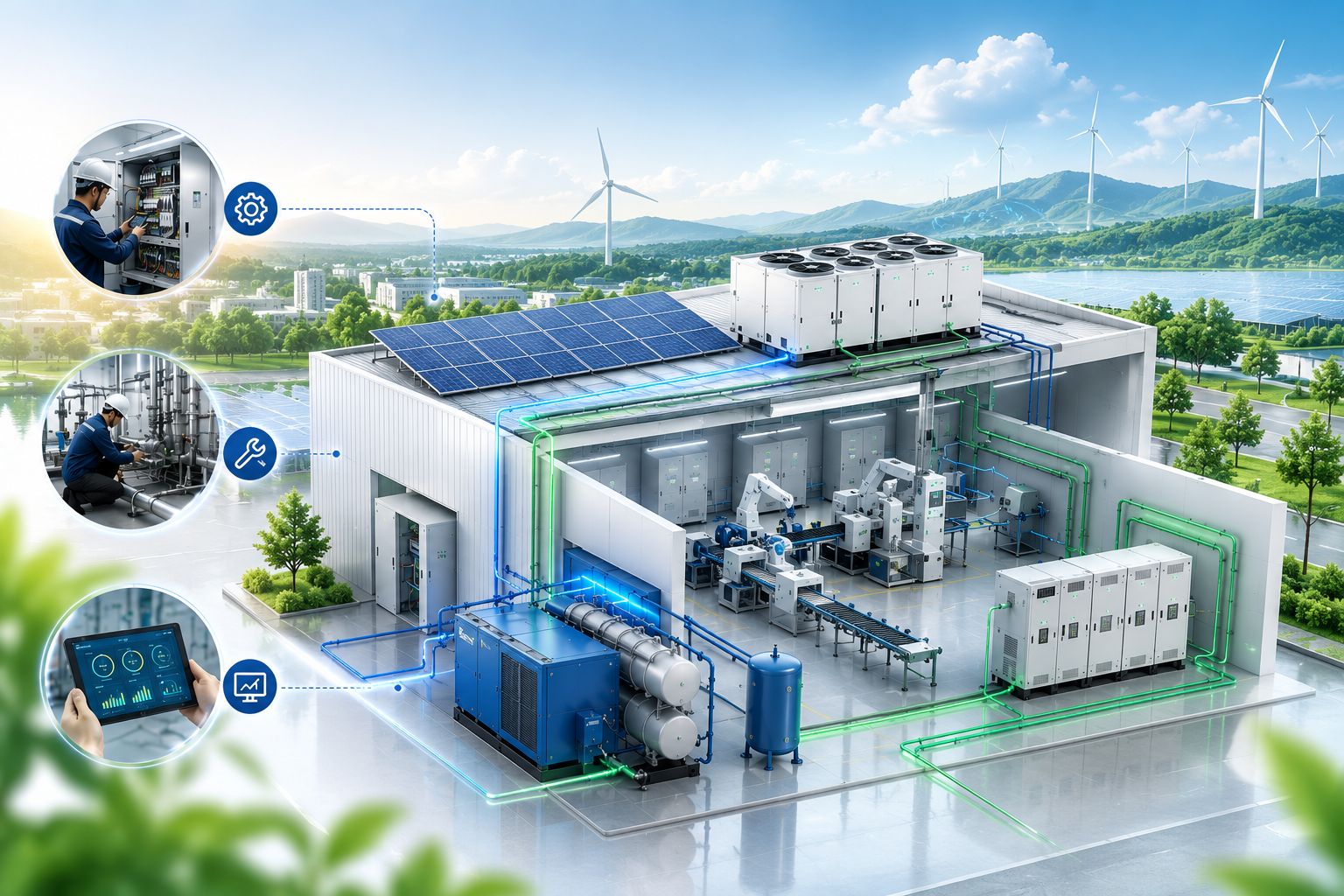
Learn how solar-plus-battery storage protects Thai factories from power outages and keeps production running without interruption.
A practical framework to help factory managers decide whether to upgrade existing equipment or replace it, plus a real 19% cost-reduction example.